|
 |


Hot Ringtones
production news & trends
studioexpresso music community worldwide
espresso
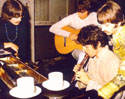
break for The Beatles
l-r:
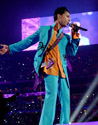
Prince at Super Bowl XLI The
quality of the
RF at Dolphin Stadium is quite a fitting tribute to kick off Sennheiser's
50th anniversary year of wireless technology.
(PHOTO CREDIT: Kevin Mazur/Wireimage) Art
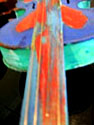
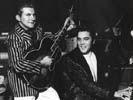
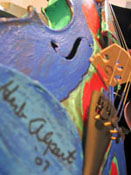
of Herb Alpert (photo: ByTheC)

Sign
up here for
SE's monthly ezine
already on the list? Refer a friend!
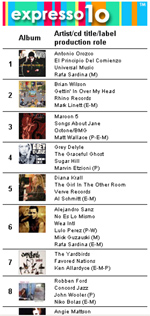
Ride On expresso10!
Each month, new releases (in no particular order) are reviewed and posted
with
expresso10 see home
page
If
you're part of studioexpresso's production community
, email details
of completed projects with SE producers/mixers/engineers
or studios
Your feedback is valued - write to the editor
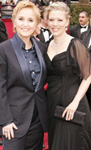
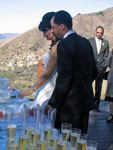
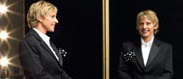
Singer Melissa Ethridge in a custom
navy tuxedo by Domenico Vacca and actress Tamy Lynn Michaels in Pamella
Roland.
Love is
real, real is love...Love is you, You and me,
Love is knowing, We can be. --John Lennon

Jordan Bratman and Christina Aguilera
at People Magazine Post GRAMMY Party Hosted by Beyonce, Feb 12; The
Grammy Show on Feb 11.
Smoked salmon oscars (by Wolgang Puck) anyone?!
“An Inconvenient Truth” won two well deserved Oscars: “Best
Documentary, Features” and “Best Achievement in Music Written
for Motion Pictures, Original Song
“I Need To Wake Up” by Melissa
Ethridge. Series of worldwide concerts to take place on July 7, 2007
with over 100 music celebs to create a foundation to combat climate change
led by The Alliance for Climate Protection, chaired by Al
Gore. Music Director Bill Ross took the orchestra rehearsals for over
120 pieces of music to Captiol
studios. Big
win for "The Departed" and Martin Scorsese --Awards in the Sound
Editing and Sound Mixing categories for Paramount's "Dreamgirls”
with Michael Minkler, Bob Beemer and Willie Burton and "Babel”
composer Gustavo Santaolalla.
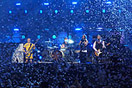
The downpour at Super Bowl XLI didn't dampen Prince's electrifying performance,
nor did it affect the crystal clear audio from his soaking wet Sennheiser
SKM 5200 microphone with Neumann KK 105-S capsule (left).
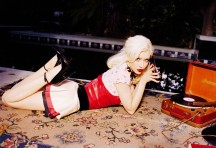
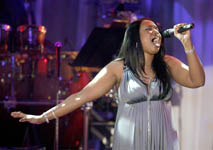
It's A Man's Man's Man's World,...sang the fully charged and in charge Christina Aguilera in a white suit at the 49th Grammy Awards. We salute her and all the women before her like Edie Sedgwick and Betty Comden who continue to inspire...March is National Women’s History Month. Like the mighty James Brown said: "...it wouldn't be nothing, nothing without a woman or a girl."
Stay with us, we'll take you behind-the-Grammy show and introduce you to the men and women who brought us the sounds and images in HDTV/5.1 sound
We invite you to take
a Jrourney of Light in April and take a sneak peak at what's hot in London
fashion and much more...Thanks for the music...read on.
Please
check back with studioexpresso calendar
for upcoming mixers & music events
|
|
|
|
North
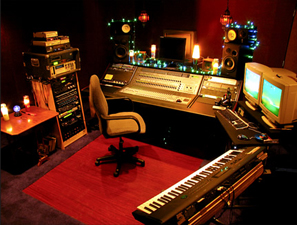
Hollywood's Dwarf Village Jeff Hull opened Dwarf Village studios to accommodate artists with fixed budgets who have appreciation for a good studio. "We offer attractive packages with or without engineering that will suit each situation,"says Hull who has branched out into film and TV music with credits to include the main title for the feature MGM film "Molly" Starring Elizabeth Shue and just finished writing & producing an album for his own band "Rush of Ushers" with his partner "Daniel O'Brien." Hull is a prolific producer, composer and arranger and Grammy nominated songwriter and musician with over 23 years of professional experience in both acoustic and electronic environments.Read more here.. |
Take
an ExpressTour of Dwarf
Village here |



Drum Doctor
world's finest collection of drums & cures for common drum ailments

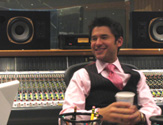
Universal artist, Matt Dusk Feb 2006 Capitol Sessions espresso
break
|
|
||||
|
||||
| Back to top |


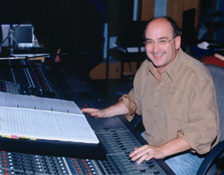
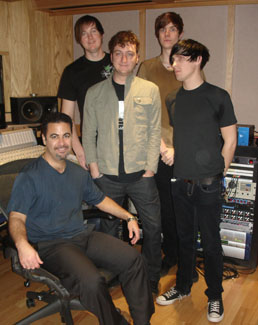


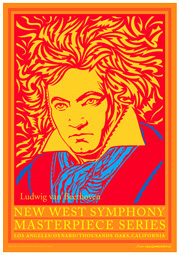
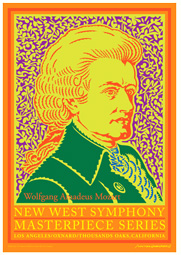
own the collectible series posters by pop artist, John Van Hamersveld

2004 Edition of the
Recording Industry Sourcebook is out

Mr
Bonzai
|
Feb 25th,
live on NBC --The
Oscars Ellen DeGeneres
hosted the 79th Academy Awards telecast produced by Laura Ziskin.
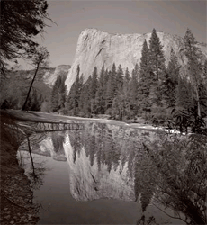
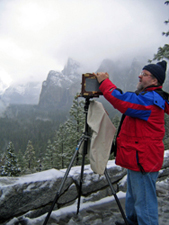
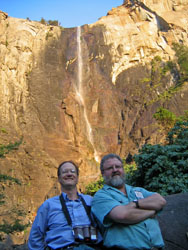
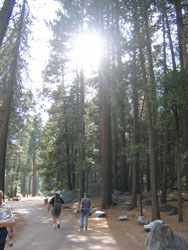
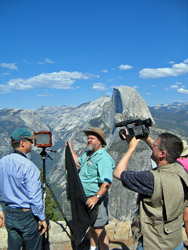
The visual component of Yosemite: Journey of Light consists of more than sixty large format traditional photographs (Ansel Adams School) blended with motion-picture photography. The photographs were created by Lawrence Janss during five trips to Yosemite that were taken over a period of more than twenty months, from spring 2005 through winter 2007.A fifth-generation Californian, Janss attended the Ansel Adams Summer Photography Workshop, the first of three summer sessions he would spend with Adams, who said of the young, aspiring photographer, “Larry is as enthusiastic as a young, muddy puppy, and as clumsy too.” Thus began a friendship that lasted until Adams’ death in 1984; it was the heart of Janss’ formative period, during which he also assisted Adams on some of his many projects. In addition, Mr. Janss has participated in advanced workshops with some of the finest photographers working today, including Bruce Barnbaum, Ray McSavanay, John Sexton, Stu Levy, Huntington Witherall, Jay Dusard and Don Kirby. In 1998, Larry was awarded a major commission to produce a photographic interpretation of Ferde Grofé’s Grand Canyon Suite, which was premiered by the New West Symphony. He took four major expeditions to the Grand Canyon for the project, and from those trips, he produced over 150 large-scale photographs that were rendered into high-density glass slides and projected above the orchestra. Janss is also the executive producer of a new feature motion picture titled My Suicide, a dark, comedic exploration into the causes of and solutions for teenage suicide. The film, starring David Carradine, Mariel Hemingway, Joe Mantegna and Gabriel Sunday, is directed and produced by David Miller.
The music of Yosemite: Journey of Light by Robert Kyr is approximately 23 minutes. The music of the first movement embodies the dynamism, raw power and primal energy of water in motion, as suggested through virtuoso and colorful writing for the woodwinds, percussion section and strings (often playing as soloists within the thundering textures). The second movement (Reflections and Solitude) features photographs taken during autumn and winter trips to Yosemite. "In my music, I aim to embody the sparkling clarity and quiet serenity of these images, especially through lyrical writing for the strings," says Kyr. The final movement (Living Granite) features photographs taken over the course of the entire project. The heart of the movement is a single panoramic vista that was shot from the same spot at Inspiration Point in every season. The vastness and grandeur of Yosemite is evoked through expansive, luminous textures for full orchestra in which the brass section plays a particularly majestic role. The instrumentation includes: 2 flutes, flute/piccolo, oboe, oboe/English horn, 2 clarinets, clarinet/bass clarinet, 2 bassoons, 4 horns, 3 trumpets, 2 trombones, bass trombone, tuba, 4 percussionists, piano/celesta, harp, strings. Kyr has composed
nine symphonies, three chamber symphonies, three violin concerti,
and numerous works for vocal ensembles. Kyr's ninth symphony—The
Spirit of Time for four soloists, chorus and orchestra—was
performed as part of an international project titled “Waging
Peace in the New Millennium.” Kyr is chair of the composition
department, and director of the renowned Oregon Bach Festival Composers
Symposium (www.iwagemusic.com), as well as the Music Today Festival,
a biennial series of concerts and events that celebrate new music
from around the world. He also directs the innovative Vanguard Concert
& Workshop Series, and the UO’s Pacific Rim Gamelan and
is professor of composition and theory on the UO music faculty since
1990. Kyr graduated from Yale summa cum laude in 1974 and continued
his education in England at the Royal College of Music in London,
and at Dartington Summer School for the Arts, where he studied with
Sir Peter Maxwell Davies. In 1989, Kyr received his Ph.D. from Harvard
University, where he studied with Donald Martino and Earl Kim. At
Oregon, Kyr has developed new models for teaching composition, integrating
theory, performance practice, and composition into a single, focused
curriculum at both the undergraduate and graduate levels. The composition
program at Oregon is presently one of the largest in the United
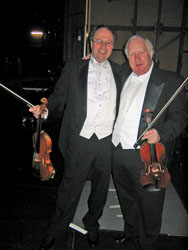
States—a thriving community of 50 composers Meet Maestro
Boris Brott, and some of LA's top musicians that make up the
New West Symphony, now celebrating its 12th
season by giving thrilling performances at Brentwood, Thousand
Oaks and Oxnard. The New West can also be heard on K-Mozart
105.1 FM (click for the schedule) with Rich Capparela on select
Sundays at 8pm. Next concert: Friday, April 13, 8:00 pm at Oxnard
Performing Arts Center; Saturday, April 14, 8:00 PM at the Countrywide
Performing Arts Center at the 2007/2008 Masterpiece
Series subscriptions
http://www.newwestsymphony.org/order2.cfm NWS AUDITION
NOTICE: April 11 and 12, 2007 – Oxnard Performing Arts
Center
2007 TEC
Awards Dates Announced MUSEXPO 2007
Performance Slots Open |
|
Watch Video
Interviews with Top producers from Legendary Studios |










Instant Access
to booking
top producers,mixers,
composer and studios
24x7
877-645-9777
toll free

Michael Schenker's
famous Gibson Flying V guitars are now available exclusively from

Brauer
Guitar Rentals


  |
|
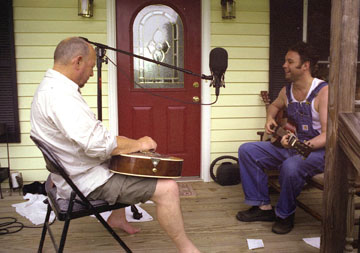
Dolph Ramseur's "Hell's Half Acre" with Martin Stephenson (left) and Jim Hornsby utilized SoundField MKV for extraordinary location recording authenticity; Stephenson of Dintees The locals
in and around the one-stoplight town of Midland, North Carolina
know it better as "Hell's Half Acre." It earned its colorful
name during the 1930's, when an unusually large concentration of
moonshine stills attracted a rough bunch of hellions to the town.
The old hellions begot little hellions, and Midland stayed true
to its nickname for decades after prohibition ended. Stephenson is
perhaps best known for his post-punk band, the Daintees, which were
contemporaries of U2, Echo & the Bunnymen, and The Smiths, but
he is most loved for his quieter, more intimate work that continues
to this day. North Carolina native Ramseur was happy to release the album on his label, which is distributed by Sony Red, provided they could record it with an authenticity that no studio production could deliver. A location-recording enthusiast, Ramseur suggested they use the ambience of his rural home, and Stephenson happily agreed. With the location set and passion for the project running high, Ramseur researched stereo microphones with the hope of upgrading his system. "I only do location recordings, and I wanted a single microphone that sounded amazing and that would be simple to set up," he explained. "Everything pointed to the SoundField MKV. The reviews were great so I arranged to get a demo from SoundField." While its use
is simple, any explanation of the SoundField MKV tends toward the
technical. The single microphone actually contains multiple capsules
that capture all three dimensions of an acoustical event and transmit
that information to a proprietary decoder in SoundField's "B-Format."
The B-Format signal contains ALL of the sound source's dimensional
information. While the possibilities of the SoundField MKV system are heady, Ramseur used a more important organ to find his sound. "I know that the MKV has a lot of different capabilities, figure-8, cardioid, surround, and so on, but I threw all of that out the window and let my ears guide me. I moved things a little bit while they were setting up, but I quickly found what sounded right and didn't need to tinker with it after that." Stephenson and his musician friends (including famed UK acoustic guitarist Jim Hornsby) first gathered around the MKV on Ramseur's eight-foot by forty-foot front porch. Ramseur set up his Alesis Masterlink two-channel recorder with a pair of trusty headphones about twenty feet away and let the feel of the place wash over the musicians and into the recording itself. Recalled Ramseur, "We taped birds, bugs, cars going down the road, and even a thunderstorm. All of those ambient noises were absolutely beautiful in the SoundField. There are five or six cars going by on the record and you definitely hear them. The recording has a context that you can practically feel." But not all
ambient noises proved a blessing. "The recording was made in
the summer of 2004, which coincided with the hatching of 17-year
cicadas," Since everything
was recorded in one pass with no overdubs, Ramseur effectively mixed
each song by moving the musicians around the MKV. "I'm no
sound guy," he continued, "but everyone who hears this
recording thinks it's out of this world. I think that's what's so
great about the SoundField MKV system - it can be so technical,
but all you have to do is trust your ears and you'll get something
spectacular. If I can achieve success with this format, then anyone
can achieve success with this format. It's really just point and
click!" For more info
on SoundField MKV system, contact Brad
Lunde at www.lasvegasproaudio.com
or Phone (702) 307-2700 or visit
SoundField
Microphones
Christina Aguilera picked up the 'Best Female Vocal Pop Performance' award for 'Ain't No Other Man' at the 2007 Grammy Awards earlier in February. Co-written by Aguilera, the album’s sexy, upbeat first single ‘Aint No Other Man’ was produced by Christina and DJ Premier. Recorded at Chalice Studios in Los Angeles, it strikes a vintage sound, which perfectly balances the old and the new and features mixes from Kardinal Beats (Destiny’s Child, Pink) and FULL PHAT (Rhianna, Usher). “This is a concept album that follows a bold, set vision,” says Christina. “The touchstones are Billie Holiday, Otis Redding, Etta James and Ella Fitzgerald.... what I used to call my ‘fun music’ when I was a little girl.” Hugely successful
among top producers, engineers and independent record labels, Solid
State Logic’s AWS 900+ Analogue Workstation System is also
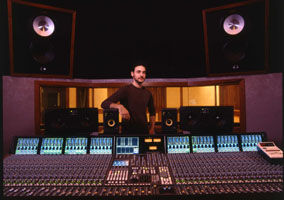
a hit among commercial recording studios Additionally, Chalice North has had Nine Inch Nails for the last month mixing with Alan Moulder mixing in Studio B, as well as Brian Michael Cox producing tracks for the upcoming Chris Brown album in Studio A. Westlake Recording Studios has also installed two AWS 900+ consoles. The consoles are housed in Westlake's Production Rooms 1 and 2, which are used for overdubs, pre-production, writing and, now, mixing. "We've heard such good things about the console," says Westlake Recording Studios co-owner Steve Burdick. "Jimmy Jam and Terry Lewis's production facilities have five AWS 900 consoles. We have a lot of history with them, and if they felt it was a good console, so do we," adds Burdick (West LA Music/Westlake Audio Are The New Dealer For AWS 900+).
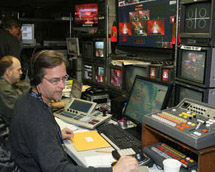
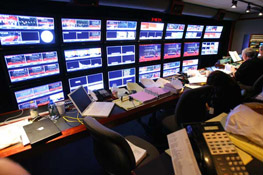
First of all, this year The Recording Academy®, CBS Television Network, and Cossette Productions combined forces for the three-hour-long broadcast, utilizing the latest in technology to provide television viewers worldwide with a cutting-edge, high-definition surround sound event. "The 49th Annual Grammy® Awards marks the fifth year that the telecast has been broadcast in HDTV/5.1 surround sound,” states Neil Portnow, President of The Recording Academy®. According to Portnow, each year the bar is raised on the overall production, particularly on the audio quality of the telecast. "We are moving to total HDTV/5.1 broadcast in 2009, so this year’s show once again helped set the stage for that transition and further extended the boundaries of broadcast television," says Portnow.
At the helm
of the Grammy Awards' technical staff are two audio pioneers, co-supervising
the audio broadcast -- multi-Grammy producer, Phil Ramone (Chairman
Emeritus of the Recording Academy's Producers & Engineers Wing)
and Hank Neuberger (advisory council member of the P&E Wing).
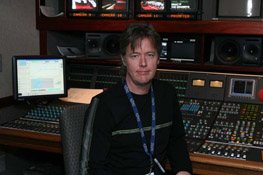
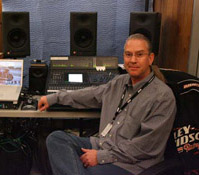
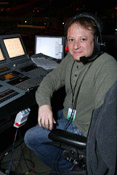
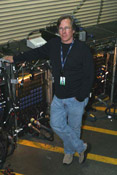
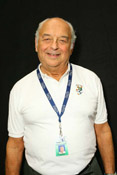
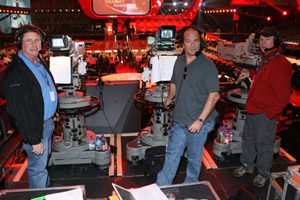
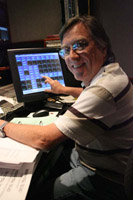
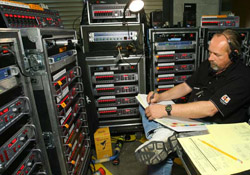
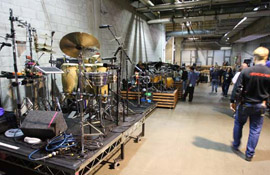
Most technicians we spoke to said that the 49th Annual GRAMMY Awards was the most complex show to date and featured expanded staging employing more than a 1000 microphone inputs, a new level of multi-channel wireless complexity, and elaborate set changes. Numerous remote trucks including the production truck where Walter Miller sits to direct the show and the XM truck (L7 truck utilized Genelec 8200 Series DSP Monitoring Systems) where the tag-team of music mixers, John Harris and Eric Schilling sit are linked from the parking space via miles of snakes to the stage. Here's a sample of audio professionals who make it all come together. Klaus Landsberg's job is to capture the audience reaction to events throughout the show and generate a full surround audio feed (for the XM Productions 5.1 truck) and front and rear feed for the LT/RT mix. Klaus who also works on the Emmys and Oscars says next to VMA's this is the biggest music show to produce. "Anytime, over 110 decibel of sound is pushed onto the stage floor, you have a lot to watch for," says Landsberg.
Joel Singer sits in the ORB (a dedicated "mirror image" broadcast truck) and does the sub-mixing of overflow inputs of orchestra that will be passed to the music and house mixers. Paul Sandweiss in the XM production OSR 5.1 truck handles all the surround sound mixes. Don Worsham is in charge of real-time music playback, pre-records, music and nominee packages. Mikael Stewart and Ron Reaves (ATK Audiotek) are FOH production mixers. Mike Parker (stage right "A") and Dave Velte (stage left "B&C") handle the monitor mixing and Andrew Fletcher & Jeff Peterson are ATK system managers.
According to consulting engineer and Recording Academy P&E Wing member Doug Mountain, the amount of gear used to produce the show is astonishing. Picture 150 tons of lighting on chained motors suspended from the ceiling hall illuminating the two-sided stage. Two-weeks of "pre-hang" or set up is required for the lighting alone. The 11 riggers are actually experienced (presumably well-insured) climbers who wear bungee-jumping type harnesses to install 13000 amps that light the performers and the hall. Fiber optic and LED technology is everywhere in sight.
Then there are extended shows like Musicares. Elliot Scheiner who has received 16 Grammy Award nominations (five wins; first took a job working for Phil Ramone in October of 1967) was in LA helping record Musicare's Person of the year, Don Henley at the convention center. Elliot's list of credits reads like a Who's Who in the music business, from Aerosmith to Grover Washington, Jr. and of coursre, Steely Dan and Donald Fagen. Most will agree that he's breathed 5.1 life into such great recordings as The Eagles' Hell Freezes Over and Sting's Brand New Day. We spoke to super engineer/mixer, Scheiner who was in town to mix the new Eagles album at Glen Frye's studio in LA. Elliot is also busy producing couple of unsigned jazz acts back in his private studio which we'll bring to you as soon as completed.
When asked what
type of preparation is required to get such a huge show off the
ground, Elliot says: The Recording
Academy's Producers & Engineers Wing puts out Recommendations
For Surround Sound Production which makes interesting reading for
those of you interested. Music Man
Jules studioexpresso met up with music vet/contractor Jules
Chaikin in the green room. Jules is a familiar name to stage and
studio managers and ace players in Hollywood. He just finished work
on Michael Buble' CD due out later this year. Jules continues work
with many arrangers and music directors to include: Jeremy Lubbock,
Johnny Mandel, David Foster, Randy Kerber, Michael Melvoin, Roger
Kellaway. You could say that over the past 53 years in the biz Jules
has worked with more artists than you can imagine --from Sinatra
, Bennett, Striesand, Ella, Sass, Carmen, Gerald Wilson, Bacharach,
Herb Alpert, Kenton, Harry James, Beach Boys, Van Dyke Parks, Jefferson
Airplane to so many more it would fill these pages. "Suffice
it to say I have had a very long, productive, successful and fortunate
career here in L.A," says Chaikin who provided the musicians
for the "Gnarls Barkley" Orchestra on the Grammy show
accompanying, Beyonce (strings), John Legend, John Mayer, Corinne
Bailey Rae, Justin Timberlake (strings), Smokey Robinson, Christina
Aguilera, Lionel Ritchie, Chris Brown, Dixie Chicks (strings). Jules
was the man in contact with all of the musicians and groups that
performed. "This was the greatest number of musicians on the
Grammys since I became the show's orchestra contractor some 17 years
ago. Three of the performances required big orchestral set ups (65
+ mic inputs) with a dedicated orchestra mixer. The miking and management
of the audio alone is a monumental task in itself. We had over 200
musicians not including the principal performers, e.g. The Police,
James Blunt, Dixie Chicks, etc," says Jules according to whom
the coordination of rehearsal times was a monumental job handled
by the talent executives. "You can imagine what had to be done
in order to reconcile the various schedules of the performing artists.
And whenever there was a slight schedule change I had to contact
all the musicians that were accompanying any particular act. It
was a very exhausting challenge, especially in light of the size
of the Staples Center and Center Staging, where most of the rehearsals
took place," says Chaikin.
Congrats also
to Elaine Martone, Senior Vice President of Artist Relations
and Production at Telarc who won a Grammy for Classical Producer
of the Year. “I share this honor with the remarkable artists
I have the privilege of producing in classical and jazz, especially
the visionary Robert Spano and the Atlanta Symphony Orchestra and
Chorus, Paavo Jarvi and the Cincinnati Symphony (both ensembles
are our longtime partners), Ben Zander and the Philharmonia, classical
guitarist David Russell, and jazz pianist Michel Camilo who lends
his amazing talents to Gershwin’s ‘Rhapsody in Blue’
– these are the artists that are represented by this award,"
says Martone. Michael Bishop won for Best Engineered album,
classical (Elgar: Enigma Variations; Britten: The Young Person's
Guide To The Orchestra, Four Sea Interludes [Telarc]. Congrats everyone!
Of Music Directing: From Idol To the Grammys
For bassist-turned-music director Rickey Minor The Grammy Awards is a piece of cake. Best known for being the music director for the smash American Idol series, Minor toured the world as Whitney Houston's musical director and produced her Super Bowl national anthem performance. He received an Emmy nomination for music direction in 2005 for “Genius: A Night for Ray Charles,” a concert tribute featuring Elton John, Stevie Wonder and Norah Jones. He has helped assemble bands for artists like Usher, Christina Aguilera, Britney Spears, and Mary J. Blige. Mr. Minor’s path to “Idol” started in South Central Los Angeles, where he moved from Louisiana with his family when he was 9. “It was a low-income, drug-infested situation,” Mr. Minor, now 47, said. But a high school music program, in which he played bass, “enabled me to move forward in life, not just career but in life.” At 19 he abandoned studies in math and computer science at the University of California, Los Angeles, to tour Europe with Gladys Knight. He had never flown before. He said: “I sat on the plane thinking: ‘They’re paying for the plane and the hotel room, and they’re paying me to play this piece of wood and these metal strings. I can do this.’ ” Back in Los
Angeles, he was working in the pit of the musical “Dreamgirls”
when he received a career-changing call from John Simmons, then
music director for the singer Stephanie Mills. Mr. Simmons asked
him to put together a band to back a singer from his church who
was seeking a record deal. That singer turned out to be Whitney
Houston.
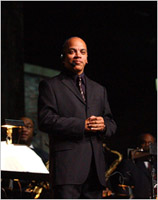
Music Honorees,
Herb Alpert & Jerry Moss
Music legend,
Herb Alpert
with partner Jerry Moss were honored earlier this month by The Recording
Academy with the President's Merit Award. "We are proud to
pay homage to this amazing duo and celebrate their incredible accomplishments
as one of the most respected and revered executive teams in music
history," says Recording Academy President Neil Portnow. Alpert's artistic
vision reverberates one note comprised of three simultaneous chords:
curiosity, integrity and excellence. An extraordinary musician,
Alpert's trumpet playing earned him five #1 hits, eight Grammy Awards,
fifteen Gold albums and fourteen Platinum albums. Alpert and partner Jerry Moss started A&M Records out of Alpert's garage in the 1960s, nurturing it into music's largest independently owned label with a roster that included The Carpenters, Cat Stevens, Joe Cocker, Sting, Sheryl Crow and Janet Jackson. Alpert and The Tijuana Brass was the label's first signed act, selling more than 700,000 copies of "The Lonely Bull" to put A&M on the map. Alpert and Moss sold A&M Records to PolyGram for $500 million in 1989 and continued to run the label until mid-1993. The duo received The Recording Academy's Trustees Award in 1997 for their contributions to the field of recording. They also received a lifetime achievement award in the non-performing category from the Rock and Roll Hall of Fame. Art
Of Alpert During the last two decades, Music legend, Herb Alpert has emerged as a talented abstract expressionist painter with international exhibitions. His canvasses are characterized by flowing shapes, bold brushstrokes and exploding colors. Alpert and partner Jerry Moss received the President's Merit Award on Feb. 11 at the 49th annual Grammy Awards. The executive duo were recognized for their impressive four-decade career in popular music.
"For those
of us in the industry, Herb Alpert represents what's known as A
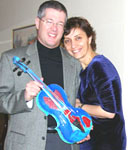
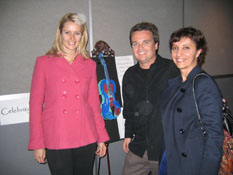
Class Act," says studioexpresso's Claris Dodge who got Mr Alpert
to paint and autograph a violin for a local symphony fundraiser
this month. Alpert
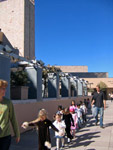
became one of the confirmed artists For the Kids. New West
Symphony's live and silent auction fundraiser on April 27, 2007
at Hotel Bel-Air allows very special guests the opportunity to bid
on one-of-a-kind collectibles, including hand-painted violins and
guitars signed by music and television celebrities to benefit the
New West
Symphony education programs.
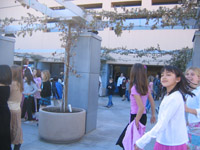
"The experience of a live performance, from the powerful sound of the music to the foreign shapes of the instruments, is magical for third, fourth and fifth graders. Our symphonic adventures each year transform lives and educate and inspire children with great perfomances by New West Symphony musicians under the leadership of Boris Brott," says Nelson Dodge, executive director of NWS. Did you know
that Los Angeles Mayor Tom Bradley proclaims June 22 "Herb
Alpert Day"?!
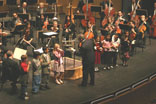
The New West
Symphony is the resident orchestra of the Wadsworth Theatre in Brentwood,
the Oxnard Performing Arts Center, and the Countrywide Performing
Arts Center at the Thousand Oaks Civic Arts Plaza. Celebrating its
12th season, NWS is one of the preeminent orchestras in Southern
California, and continues to thrill audiences with its virtuosity,
richness of sound and outstanding artistic excellence under the
leadership of Music Director Boris Brott. NWS supports educational
programs to include: Symphonic
Adventure concerts for over 100,000 school children, NWS's music
education DVDs reach 400 classrooms. NWS's Music Van, a nationally
acclaimed program, offers third grade classrooms "hands-on"
experience with orchestral instruments worth thousands of dollars.
The 2006/07 Masterpiece Series Performances offer virtuoso guest
artists to include: Pepe Romero (guitar), Jon Kimura Parker, Christopher
O'Riley, Antonio Pompa-Baldi (piano), Elmar Oliveira (violin), Cynthia
Jansen (mezzo-soprano.) For concert schedule and tix visit www.newwestsymphony.org To participate or Support For The Kids program, contact Carl Schurtz, General Manager, New West Enterprises directly via email [email protected] or call (310) 694-3550
Fashion
Week In London TheAutumn/Winter 2007 collection brought patterns and colors out and gave "painted ladies" a new meaning with bold intricate makeup lines that would make some Australian or African tribes blush.
studioexpresso
brings you the Manish
Arora - Runway from the February 12, 2007 - at BFC Tent, Natural
History Museum in London, Great Britain. The Indian fashion designer
presented a vibrant autumn-winter 2007 collection, a futuristic
vision set out in technicolor that wowed the audience. With a rich
set of embroidered and psychedelic prints, the designer played with
materials to add a sense of relief and optical illusions to dresses
structured in a slight trapeze or tulip, inspired by the 1960s.
An Artful
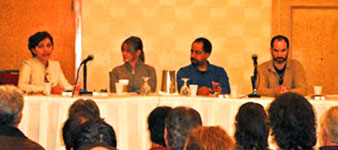
Afternoon With Eddie Kramer & Friends The two-session
panel included: Session I - Marketing Music with attorney Dean Sheldon
Serwin (BMI, Capitol); KCRW host and music supervisor Anne
Litt, and Geffen Universal Music Group Marketing exec, Tim Reid
(Snoop Dogg, Common, Mos Def). Session II - Making Music with: The playback session began with a selection by Kramer who surprised everyone with a recent production of Zeppelin. Say what...Recent?! Then Eddie introduced the all-girl tribute band from NY, Lez Zeppelin who recorded the LED covers and drive club audiences to a frenzy, now successfully touring in US and Europe.
SSL's Lure
For Lohr Mono Music Studios, owned by legendary composer/producer Benny Andersson, has installed a Solid State Logic Duality console. The 96-channel Duality allows the studio to maintain the classic SuperAnalogue™ sound of SSL consoles and take advantage of full integration with the latest digital audio workstations (DAWs). Mono Music is integral to both the domestic music scene and the recent Swedish phenomenon of recording international hit records for major stars. Lohr, for example, works with major pop artists at Mono Music, having recorded and mixed singles for Britney Spears, Backstreet Boys, Westlife and Céline Dion, among others. "Recently, I've also been doing some special Abba projects," he adds, "like the Abba In Concert DVD and the new release of Abba: The Movie, which we've remastered in 5.1. One of the reasons we needed a newer desk was 5.1-channel audio, and the surround facilities on Duality are terrific. The new surround panning is great-no other desk has anything like it. "I've been working on SSLs since 1985," Lohr concludes, "so I know them really well. Duality compares so well, with its sound and also the EQ and dynamics. Even if I hadn't tried it before buying, I knew that it would be top quality." Duality
At Archon Producer/engineer Aris Archontis has taken delivery of North America's first Solid State Logic Duality console. The large-format Duality, which combines the analogue sonics of legendary SSL E, G & K Series consoles with extended Digital Audio Workstation integration capabilities, is housed at his new, Chris Pelonis-designed private recording studio, Archon. Archontis has been working with recording artists and independent bands since relocating from London to Boston, where he graduated from Berklee College of Music. Migrating to Los Angeles, where he worked for two production companies, he has now completed his personal studio and resumes music production with SSL's next-generation Duality. "It was like someone had finally answered my prayers. Groups, plenty of busses and sends, automation, unparalleled routing, DAW control and a great master section-all under one hood with incredible sound quality, and no giant power supply in sight," says Archontis. Othe News From SSL Solid State Logic recently-introduced XLogic Delta-Link MADI HD, a professional MADI converter for studio, live and broadcast applications, now shipping worldwide. Delta-Link MADI HD facilitates direct interconnectivity between Digidesign Pro Tools|HD® systems and MADI-enabled audio equipment.
The World's
Greatest Rock 'n' Roll Band
New York's Remote
Recording was on hand at New York's Beacon Theatre for the Rolling
Stones' Oct. 29 and Nov. 1 concerts, filmed by director Martin Scorsese
for an upcoming documentary. Elite engineer/producer Bob Clearmountain, who mixed the Stones' Tattoo You, Still Life and Stripped albums as well as individual tracks from their storied catalog, was at the helm in the Silver Studio to record the latest performances on the band's A Bigger Bang tour, as well as the many afternoon and evening rehearsals in the preceding days. Clearmountain estimated that he has recorded and mixed over 30 Rolling Stones concerts since his first in 1981-the Still Life/Let's Spend the Night Together concerts that also heralded Remote Recording's long association with the band. "This is the second Stones movie that David [Hewitt, Remote Recording founder] and I have done together," he noted, along with several pay-per-view broadcasts. "I was a big fan of The Last Waltz and of the Band," Clearmountain summarized, "and just watched it recently. If this comes out half as great as that film, it will be really special." "Working
with the Rolling Stones is always exciting, but having the opportunity
to work with them in such an intimate environment at the Beacon
made it even more amazing," commented Karen Brinton, Remote
Recording owner/manager. "Throw Martin Scorcese on top of that,
and you've really got something special. Having Bob Clearmountain
on the truck was fantastic as always, and I'm grateful for the experience.
I wish it happened more often!"
Singer-songwriter,
Elan may just be one of the most successful independent Latin artists
around. At age 4, she started writing her first songs and her father
recorded them in their makeshift-home studio. The story goes that
BMG International, Vice President of A&R, Richard Sweret (Sarah
McLachlan) flies Elan and band mate/producer Jan Carlo to meet then,
Arista Records President & CEO Antonio LA Reid. After a private
showcase in which Elan played "Perfect Life, LA Reid stated
that the song was "the story of my life" and offered her
a record deal. In 2003, after leaving Arista, Elan released her
first single Midnight in Mexico on her own label, Silverlight Records
(licensed through Sony Music Mexico) to unexpected and overwhelming
response. Midnight climbed the "Pepsi Chart" to #1. She had success
with MTV Latin America and Australian radio. Her second self-released
album, London Express finds its roots in the music of The
Beatles, which Elan has described as "the only band that really
changed everything." This Fool's Life" was the second
single released from Elan's latest album. It had the highest rotation
on the radio in many Latin American countries.The video for "This
Fool's Life" was also an outstanding success. Now the band
has finished shooting (release date TBD) the video for her upcoming
single from the New Album "What Can Be Done At This Point,"
directed by Gulliver Parascandolo. This is Elan's ninth released
video. Six of the videos previously released have had active fan
votes and chart and digital download activity. Visit Elan at
myspace or at elan.com
Elan's NEW album "What Can Be Done At This Point" is available
NOW for
pre-order! Recording
Dave Matthews Band At Haunted Hollow According to
engineer and producer Steven Miller, before recording at Matthew's
Virginia studio, he
Virgin/HBO Deal Virgin Media inked a deal to deliver on-demand content for a selection of HBO hits, including "The Sopranos" and "Six Feet Under" to the U.K. market. Former Vice President Al Gore also will make his user-generated content channel, Current TV, available through Virgin. Further award-winning series and mini series will include Curb Your Enthusiasm, Band of Brothers and From the Earth to the Moon. The HBO subscription service will be available as part of the standard monthly charge for Virgin Media customers taking the top ‘XL’ TV package. The agreement sees Virgin Media strengthen its TV-on-demand offering with further compelling content, following recent deals with Channel 4, The Walt Disney Company’s Buena Vista International Television and Alliance Atlantis. Ernie Cormier,
chief commercial officer of Virgin Media, said: “We are making
a serious investment in the range of on-demand programs we offer
and HBO has a reputation for producing some of the most original
and entertaining shows of recent years
Record It
Today; Sell It Tonight!
In The Game
with Noize His US-based music-distribution company Sumthing Else Music Works had an inauspicious start until founder, Nile Rogers discovered video-game soundtracks. “For a while, we just had a few titles; then Halo came into the office,” he said of the video game that made Sumthing Else’s fortune. “Then, we started talking. The composer was great, the music was magic.” Sumthing Else got the distribution rights to American composer Marty O’Donnell's work on the sequel Halo 2. The two are now collaborating on the soundtrack for Halo 3. Rodgers encourages budding game composers to be prepared to go into movies as well. He cites hip-hop act Organize Noize as video-game composers who ended up producing the score to Hollywood movie Miami Vice. “This year, we are aggressively going after more game composers. I want to get these composers out there,” he said at a Midem conference this year. Organized
Noize Productions Members: Patrick “Sleepy” Brown,
Ray Murray, Rico Wade
WMA Adds Agents New William Morris Music agents will work alongside WMA's existing literary and television agents in the London office, which is overseen by Managing Director Caroline Michel. Among them: Ed Bicknell – former manager of Dire Straits, Mark Knopfler, Bryan Ferry, Gerry Rafferty and The Blue Nile – will serve as Worldwide Head of WMA’s International Music division. Bicknell will be joined by David Levy, from I.T.B.; as well as Adele Slater and Russell Warby, from The Agency Group; Nick Cave, Steve Hogan, and Solomon Parker from Concorde International Artists; Diana Richardson, from Sensible Events; and Hamish Crombie, who was already atWilliam Morris. "Under the leadership of music industry veteran, Ed Bicknell, WMA is now poised to provide an all-encompassing range of services to managers, artists, andpromoters around the globe," said Worldwide Head of Music, Peter Grosslight. "I am delighted to announce a significant expansion of the William Morris Agency in London, which underscores our commitment to the importance of the international marketplace and gives the agency global depth and breadth," said Chief Executive Officer Jim Wiatt.
Founded in 1898, the William Morris Agency is the largest and most diversified talent and literary agency in the world, with principal offices in New York, Beverly Hills, Nashville, London, Miami Beach and Shanghai. The Agency represents clients in all segments of the entertainment industry, including Motion Pictures, Television, Music and Personal Appearances, Broadway Theatre and Theatrical Touring, Book Publishing, Commercial Endorsements, Sports Marketing and Corporate Consulting
Capitol +Virgin
= Capitol Music Group
It's no secret that the A&R shuffle continues to accelerate. Ron Laffite exits Capitol, Brian Postelle exits Virgin, Cliff Audretch III joins Universal South, Caroline Records is reactivated with Jeff Rougvie as GM and Jermaine Dupri joins Island as President/Urban. Former V2 President Andy Gershon has moved to Epic and former Virgin President Matt Serletic has opend a new label. In the Publishing world, Industry veteran Steve Smith has formed Anthem Entertainment, EMI Music Publishing names Stephen Dallas, Sr. as Director of Business/Legal Affair and in the Film & Television Music world, Paramount TV and CBS TV Music Departments have merged and moved to a new location. As for the new
Capitol Music Group, Flom, who joined EMI as Chairman and CEO of
Virgin Records America in November 2005, now reports directly to
Eric Nicoli, the Chief Executive Officer of EMI Group and will now
oversee the combined Capitol and Virgin rosters in the United States.
Andrew Slater, who has been President and Chief Executive Officer of Capitol Records in the US since 2001, has stepped down from his post. "I would like to thank Andy for his contribution to Capitol and EMI over the past six years and wish him well in all that he does in the future," said Nicoli. The formation of this combined label group is part of EMI Group’s recently announced restructuring program, designed to deliver £110m ($217 million) in annual savings across its business. Bruce Lundvall, President and CEO of The Blue Note Label Group, will continue to report directly to Nicoli, as will EMI Music North America Chief Operating Officer Ivan Gavin and EMI Music North America Chief Financial Officer Colin Finkelstein. EMI Music Marketing President Ronn Werre, Capitol Nashville President and CEO Mike Dungan, EMI Christian Music Group Chairman/CEO & President Bill Hearn and Caroline Distribution General Manager/SVP Bill Hein will all continue to report to Ivan Gavin. "The combined
Capitol Music Group under Jason Flom will become part of a portfolio
of labels that position us to be best-of-class in all genres in
the US market: the new Capitol Music Group, our very successful
Capitol Nashville label, the market-leading EMI Christian Music
Group, The Blue Note Label Group aimed at the adult music buyer,
our US Latin label EMI Televisa Music, EMM’s terrific catalog
business and Caroline as a full service distribution and marketing
arm for the independent label area," said Nicoli. Polar Express
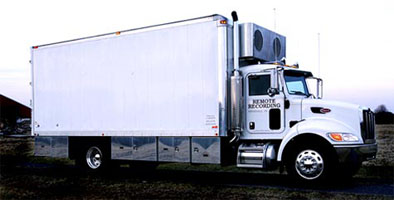
& Scheiner Capture 40th CMA Awards The 40th annual CMA Awards was broadcasted live on Nov. 6 from the Gaylord Entertainment Center in Music City. Legendary engineer/producer Elliot Scheiner served as the broadcast's Audio Producer and oversaw all aspects of the production's audio from Remote Recording's Polar Express, the newest truck in its fleet. The Polar Express is equipped with two Yamaha DM-2000 digital consoles, a pair of 128-track AMD 64-bit Dual Processor Nuendo systems, and Pro Tools|HD rig. This year, the CMA Awards were broadcast in surround sound for the first time. The multichannel mix was created in the Polar Express, Scheiner explains. "ABC was sending viewer feedback to us while the show was on the air," he recalls.Vocal mics, as well as all announcers' microphones, were handled in the Polar Express, which also hosted the audio sweetener. The live bands' audio came from the MTV Nashville truck, which was also on hand. "It's a lot to oversee," says Scheiner. "There's so much going on." Scheiner is a frequent presence in Remote Recording trucks, often recording or mixing in the Neve VR-equipped Silver Studio. He has also worked with Remote Recording founder David Hewitt on literally dozens of projects. "I've worked with Dave since he had the Record Plant truck," Scheiner recalls. "We've been working together for some 30 years. The prestigious CMA Awards add to the long list of high-profile events Remote Recording handled in 2006, including the Rolling Stones' first-ever concert in Austin, TX, recorded by Ed Cherney for an upcoming DVD, and the band's two-night stand at New York's historic and intimate Beacon Theatre, recorded and mixed by Bob Clearmountain for Martin Scorsece's upcoming documentary on the World's Greatest Rock 'n' Roll Band. Remote Recording's Karen Brinton said, "We started the year with the Academy Awards, and rounded out the year with the Rolling Stones and the CMA's. David being inducted into the TEC Hall of Fame at the AES Convention by Ed Cherney and Elliot Scheiner was the cherry on a hot fudge sundae of a year!"
Tony Brown
And Tim DuBois Exit Universal South Universal South was a joint venture with Universal Records in New York with Brown and DuBois having autonomy to sign artists. Artists signed included: Dean Miller, Holly Lamar, Allison Moorer, Bering Strait and Joe Nichols Brown —
who is largely credited with the early '90s resurgence in country
music, producing hit records for Vince Gill, George Strait, Reba
McEntire, Trisha Yearwood and Wynonna Judd, among many others —
said he was open to continuing to produce those MCA acts. He expects
to produce records for Universal South once the new company is “fired
up.” He produced the single of the Year
Forplay Sessions Forplay™ Inc., a leading designer and manufacturer of ultra-sexy women's lifestyle fashion and apparel www.forplayonline.com; and Water Music Records™, a leading dance and chill-out record label distributed by the Universal Music Group™ www.watermusicrecords.com, have announced a joint-venture to produce Forplay™ branded music for worldwide distribution. The announcement was made by Houman Salem, the CEO of Forplay™ and Brad Pressman, the President of L.A.-based Water Music Records™. Under the terms of this multi-year agreement, Forplay ™ and Water Music Records™ will produce, market, and distribute two separate collections of Forplay™ branded CDs simultaneously. The first collection titled "Club Forplay" will feature a compilation of all dance music, while the second collection titled "The Forplay Sessions" will feature tracks of down-tempo, lounge, and chill-out genres of music. "Combining music with our particular style of fashion is an essential component of our global brand strategy," commented Salem. "Music adds a third dimension to Forplay™ by giving it a voice and personality that will allow consumers to align with our brand. In addition, we will now have the vehicle to exploit fast emerging digital technologies such as YouTube, iTunes, and MySpace to create awareness and further reinforce the Forplay™ brand," concluded Salem. Water Music Records is an L.A.-based recording company operating under the Universal Music Group family of companies. Founded in July of 2000 by record industry veteran Brad Pressman, Water Music Records releases, markets and distributes music in various sub-styles of Electronica including Chill Out, Lounge and Down-Tempo music. Its sister label Water Music Dance releases CDs, EPs and Singles in the Trance, Dance and Techno genres. Considered one of the leading Dance and Chill Out labels in the Unites States, Water Music Records has achieved over 15 Top 50 albums and 2 Top 25 singles. Since its inception, Water Music Records has released over 110 projects, both artist albums and various compilations. For more information about Water Music Records.
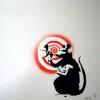
City Rats By Banksy
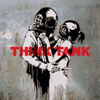
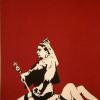
Think Tank is the seventh studio album by English rock band Blur, released in US and Uk in 2003. Freehand graffiti artist turned stenciller, Banksy was responsible for the cover art who is best known for featuring striking and humorous images occasionally combined with slogans. The anti-war messages include animals such as monkeys and rats, policemen, soldiers, children and the elderly. He also makes stickers (the Neighbourhood Watch subvert) and sculpture (the murdered phonebox), and In 2006, Banksy held an exhibition called Barely Legal, billed as a "three day vandalised warehouse extravaganza" in Los Angeles on the weekend of 16 September. The exhibition featured a live 'elephant in a room', painted in a pink and gold floral wallpaper pattern. After Christina Aguilera bought an original of Queen Victoria as a lesbian and two prints for £25,000 [5], on 19 October 2006 a set of Kate Moss paintings sold in Sotheby's London for £50,400, setting an auction record for Banksy's work. The six silk-screen prints, featuring the model painted in the style of Andy Warhol's Marilyn Monroe pictures, sold for five times its estimated value. His stencil of a green Mona Lisa with paint dripping from her eyes sold for £57,600. Banksy somehow managed to place one of his pieces into New York’s museum of modern art. The gallery’s security don't have the slightless clue how the artist did it. Guerrilla artist", "art terrorist" or "prankster" it's Banksy and you can ck it out here Artificial Gallery
Moments Before and After The Grammy Show
Music's second
biggest night, the Clive Davis pre-Grammy gala at the Beverly Hilton,
was the traditional glittering affair this year, where nominees,
presenters, record industry executives and
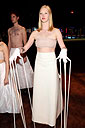
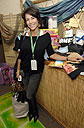
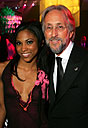
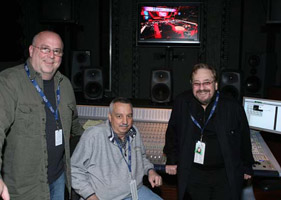
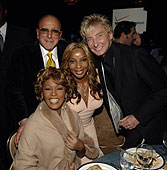
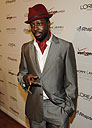
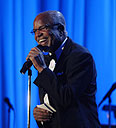
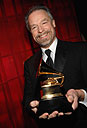
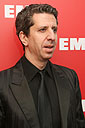
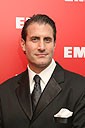
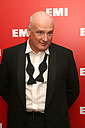
l-r: Michael Bishop, winner Best Engineered Album, Classical; People Magazine Post GRAMMY Party Hosted by Beyonce; Jason Flom, CEO of Capital Music; Lee Trink, President of Capital Music; Eric Nicoli, Chairman, EMI; Trish Sie, Director of OK Go's 2007 Grammy winning Best Short Form Music Video "Here it Goes"
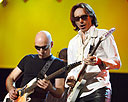
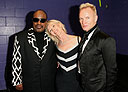
Warner Music Group After Party - Arrivals, February 11 - l-r Sting and Trudie Styler with Don Henley; Scarlett Johansson; Joe Satriani and Steve Vai perform; Stevie Wonder with Sting and Trudie Styler
Shinoda
Art
I first heard
rock and soul songs on a tiny crappy-sounding transistor radio,
and it changed my life completely. It was sonic, but it was also
a social and cultural message that electrified me. Now I’m
not saying that tinny sound should be considered satisfying or desirable,
but it’s amazing how lo-fi or lo-rez information can communicate
a huge amount.
"People
love things like Myspace and YouTube, but the essence of it to me
is: OK, just play the song,"
"As soon
as music videos came along, people started listening with their
eyes as well as their ears. It's (today's music) ...lot more lawyer
and quarter-to-quarter-driven...Now people just want a song or two
for their iPods. It seems like it's just piecemeal. But the good
thing is that does entice people to explore catalogs."
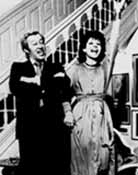
Betty Comden
"Singin' in the Rain," "New York, New York." Comden collaborated with Adolph Green on some of the greatest stage and screen musicals and won seven Tony Awards together. A salute to women writers. Factory Girl
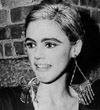
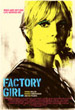
Before Paris Hilton, there was Edie Sedgwick (1943-1971), the original “celebutante” who briefly took the world of ’60s pop culture by storm. She received her 15 minutes of fame courtesy of the man who coined the concept. Andy Warhol’s downtown loft, The Factory, was a place where musicians, artists, actors and all types of misfits gathered to create art and movies, and to throw fabulous parties at night! It was here that Edie takes her place as the Factory’s most alluring and irresistible Superstar. The Cult wrote a song about her life called "Edie (Ciao Baby)" which was on their Sonic Temple album released in 1989. The Velvet Underground song "Femme Fatale" (on the album The Velvet Underground and Nico) was written about her at Andy Warhol's request. She is rumored to be one of the inspirations behind Dylan's seminal 1966 opus Blonde on Blonde, "Just Like a Woman" and "Leopard-Skin Pill-Box Hat." It's been told that the song "Like a Rolling Stone" was also inspired by her. Here's to the poor little rich girl who had it all and lost the most important part of the equation. Herself. Now the filmmakers have taken her, the object of the underground fascination for forty years and turned it into a film. George Hickenlooper directed "Factory Girl", released this month from MGM with Guy Pearce (Worhall) and Sienna Miller (Sedgwick) may not capture the magic of the muse but it details her human side. Watch a short on YouTube The Ciao Manhattan Tapes Sedgwick who had a brief modeling career appeared in Vogue (1965 and March 15, 1966) and LIFE (September 1965)
All you need
is LOVE! |
| studioexpresso
-- where you can find trusted names in music to work with COME TOGETHER! Your feedback is valued and welcomed - feel free to contact us via e-mail or phone Thank you! |








 Happy
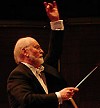
Birthday John Williams He turned 75 on Feb 8th and won two Grammy
awards in the Best Soundtrack category for his score to Memoirs
of a Geisha, as well as for Best Instrumental Composition for "A
Prayer for Peace" from Munich.
Happy
Birthday John Williams He turned 75 on Feb 8th and won two Grammy
awards in the Best Soundtrack category for his score to Memoirs
of a Geisha, as well as for Best Instrumental Composition for "A
Prayer for Peace" from Munich. 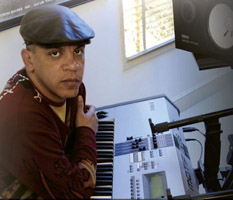




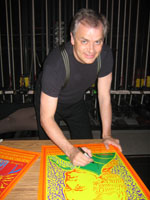












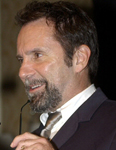










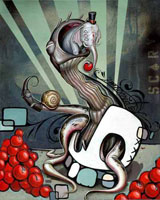 Mike
Shinoda can trace his roots as an artist back to age 3. "When
my parents would take me to dinner, they would give me a napkin
and pen when I was done eating so I wasn't squirming around,"
he recalls. Now, approximately 25 years later, Shinoda hosted the
first exhibition of his visual art, Diamonds Spades Hearts Clubs
last November at Gallery 1988 in Los Angeles.
Mike
Shinoda can trace his roots as an artist back to age 3. "When
my parents would take me to dinner, they would give me a napkin
and pen when I was done eating so I wasn't squirming around,"
he recalls. Now, approximately 25 years later, Shinoda hosted the
first exhibition of his visual art, Diamonds Spades Hearts Clubs
last November at Gallery 1988 in Los Angeles.