Justin Gray
producer l engineer I composer I musician I studio owner
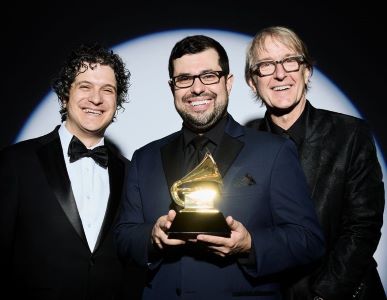
Justin Gray won a Grammy® for Best Immersive Audio Album during the “Music’s Biggest Night” in 2026. "My studio is a world-class facility equipped for stereo and immersive audio music production (Dolby Atmos & Sony 360RA). As a mix engineer, mastering engineer and producer, I work with artists from around the world in a wide range of musical styles," says Gray, a Juno award-winning bassist, composer, engineer, producer, and educator based in Toronto, Canada. His Jazz Album Avataar's Worldview won a juno.
Over the years, Justin has worked with artists of diverse genres — from hip-hop with icon Snoop Dogg to pop powerhouse Olivia Rodrigo, R&B Queen Brandy to the guitar hero Carlos Santana. His home-based Canadian artists include: Arkells, The Sheepdogs, Mother Mother, and Jann Arden. He has collaborated with Blackbear, Christina Perri, Orville Peck, Peach Pit, Tanya Tagaq.
His songwriting and production work appears with names like Avril Lavigne, Mariah Carey, John Legend, Luis Fonsi, and Joss Stone. Over the course of his career, Justin has received several awards and distinctions, including: 2020 CFMA Nominee (Best World Album), 2018 CFMA Nominee (Best Solo Artist), 2017 Canadian Screen Award (Co-Producer of Best Original Song), 2015 Emerging Jazz Artist Award (Toronto Arts Foundation) and 2015 CFMA Nomination (Best World Album).
In 2010, Justin invented and co-created the Bass Veena, an instrument designed for Indian classical and contemporary world music performance. The instrument was built and co-designed by renowned Canadian luthier, Les Godfrey. The Bass Veena is a hybrid fretless bass, which draws inspiration from North Indian stringed instruments, primarily the Sarode and Rudra Veena. The Bass Veena features 4 main playing strings, 2 drone (chickari) strings, and a 10 string short-scale harp. This instrument was conceived and built during a period of time when Justin lived in Kolkata, India, studying Hindusthani classical music. Currently, Justin performs on Bass Veena with artists from around the world in traditional and contemporary settings. He composes original music for the Bass Veena, which he performs with his ensemble Justin Gray & Synthesis. Enjoy this studioexpresso Interview with Jason Gray for our April 2026 issue
Enjoy this studioexpresso Interview with Justin Gray for the April issue
SE: Why the bass? Your music education background?
JG: I started playing bass when I was 12 to join a band with my friends. From that moment on, I knew music was my deepest passion. I was fortunate to have a dedicated and gifted teacher when I was young who taught me discipline, ear training, reading, and theory, and demonstrated a deep respect for music. From there, I attended university for music performance at the same school where I am now a professor of audio production (Humber Polytechnic). I also pursued my master’s in composition and ethnomusicology at York University in Toronto. Outside of my academic studies, I have been and continue to be a lifelong student of music. I have had the pleasure of studying and playing with master musicians from around the world, including time spent living in India studying traditional Hindustani classical music.
SE: Past production or mixing credits?
JG: I have had the honour of working on thousands of songs in both stereo and immersive formats over my career, and each has been an important part of my journey. A few notable artists I have worked with include Olivia Rodrigo, Snoop Dogg, The Tragically Hip, Brandy, Nelly Furtado, Mother Mother, Blue Rodeo, Arkells, Jann Arden, Karan Aujla, Mae Martin, Marcin, Lola Brooke, and Josh Ross.
SE: Mention A Few artists featured on Your Immersed Album?
JG: I will highlight a few artists who made significant contributions to this music: Drew Jurecka — Album co-producer and violinist on all songs; also contributed string arranging and engineerin Suba Sankaran — Carnatic vocalist and composer of the solkattu on Repose Shawn Rompré — Drummer, co-writer, and co-producer of Tapestry Ed Hanley — Tabla player and co-writer of Pendulum Todd Pentney — Keyboardist across the album Derek Gray — My younger brother and drummer/percussionist on the majority of the album For full credits, visit www.justingraysound.com/immersed.
SE: How did you get into mixing/recording? School or self-taught?
JG: My love for the recording arts began during my undergraduate studies, when I became deeply fascinated by the recording process. As I spent more time in the studio after graduating as a professional bassist, I found myself equally drawn to the control room. At that stage, I began learning from a mentor of mine, Jeremy Darby, a legendary engineer in Toronto. Although I did not attend school specifically for audio engineering, I also do not consider myself self-taught, as I have had strong mentorship throughout my career. I built my first studio for editing and pre-production in my basement. As I began producing more records, I built a dedicated studio in my backyard designed for mixing and mastering. I developed my skills in post-production one project at a time, while continuing to learn from mentors across the global audio community. I am a member of the AES and the Recording Academy, and an avid NAMM attendee. Over the past 20 years, I have been involved in every stage of production: performing, recording (on location and in the studio), producing, editing, mixing, and mastering. Additional mentors include Bob Katz, Michael Romanowski, Morten Lindberg, Jonathan Wyner, Peter Cook, and David Travers-Smith.
SE: What inspired you to work in immersive audio?
JG: I have been drawn to multi-channel audio for decades. As a listener, I have always loved experiencing music and film in surround. I go to the cinema as much for the sound as for the picture. Through formats like DVD-A, SACD, and Blu-ray, I developed a deep connection to spatial listening. As soon as I had the opportunity to create music in surround, and eventually immersive, I fully committed. It feels like a natural extension of how I hear music. My goal with a cinematic album experience is to place the listener inside the music, surrounded by the ensemble. The visual component was never an afterthought; it is part of the same world. I composed IMMERSED as a 16-channel work (9.1.6), using speaker locations as compositional anchors to position sound in front, beside, behind, and above the listener. My speakers of choice are the Lipinski L707 and PMC MB2 XBD—both exceptional mastering monitors with clarity, depth, and precise imaging.
SE: Top two favourite tools composing and mixing?
JG: As a mixing engineer, Pro Tools is my primary tool. After more than two decades, it has become an extension of my creative process. As a composer, my Boomerang looping pedal is essential. I like to improvise and let ideas develop naturally, using bass, guitar, piano, voice, and looping to explore ideas over long sessions.
SE: Best advice to up-and-coming artists?
JG: Put in the work, trust the process, and never stop learning. Music is an endless ocean of possibilities. I have been fortunate to receive many opportunities, and in each case, I was prepared because I had put in the time. A musical life is not a sprint; it is a lifelong pursuit built on strong foundations. In many ways, I still feel like I am building mine. SE: Best advice you’ve received? JG: Listen deeply. Everything in music begins and ends with listening.
SE: Do you have your own studio? Favourite studios?
JG: I have my own mixing and mastering studio designed for both stereo and immersive work. Some of my favourite studios include Michael Romanowski’s Coast Mastering, Humber College’s Gordon Wragg Recording Studio, MSM Studio in Berlin, and Abbey Road. SE: Dream collaborations? JG:Herbie Hancock, Jacob Collier, Anoushka Shankar, Pat Metheny, Jonny Greenwood, Derek Trucks, John Mayer, and Questlove.
SE: Recent projects?
JG: I am grateful to be regularly mixing and mastering. Recent releases include: My World Is the Sun (Dominique Fils-Aimé), Nostalgia (Mother Mother), Between Us (Arkells), A6 (Lights), Made It to the Moon (Jamie Fine), and Just Wait a Minute (Elysia Biro).
SE: Advantages of being a Canadian musician?
JG: Canada has an incredibly diverse and high-level music community. As a producer and engineer, I have the opportunity to collaborate with world-class artists across many styles, often blending different musical traditions. SE: What do you do outside of music? JG: Spend time with my family and my dog.
SE: Where has music taken you?
JG: India — studied Hindustani classical music Europe & USA — performing, engineering, and teaching Mexico & the Caribbean — teaching and engineering
SE: The Bass Veena — creation process?
JG: The Bass Veena was invented by me and built by master luthier Les Godfrey. It was designed specifically to support the music I was imagining. The process began with researching stringed instruments from around the world to understand what was possible. From there, I defined both technical and aesthetic goals and worked closely with Les to bring the instrument to life. It was a deeply collaborative process, and the instrument remains central to my work more than 15 years later.