|

Firehouse, the recording hot spot!
Housed in the
livery of Pasadena's 1889 Firehouse, this groundbreaking facility
founded by Producer/Songwriter Tena Clark (Betty Crocker,
General Mills, Johnson & Johnson, Kelloggs, Mead Johnson,
7 UP, Target, Toyota, United Airlines and Victorias Secret),
is the perfect mix of analog and digital recording.

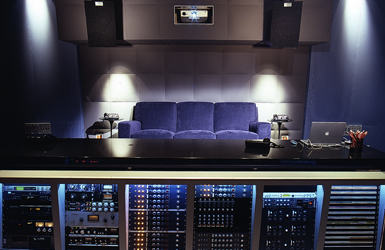
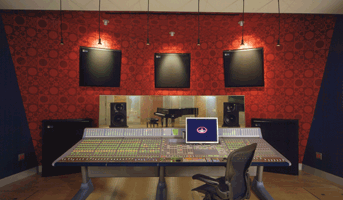
control
room A with Pro Tools HD3/192 system
After more than
a year of planning and building, Firehouse is open and has already
catered to clients like Universal Music, Disney, Kellogg's --Lifetime
Achievement Award and Grammy Award-winning songwriter Lamont
Dozier, who has used the studios to track and mix his latest
album. Recent projects include: Oscar Castro-Neves produced Patty
Clark's new release as well as his own album. Also, Yellowjackets
and Foreplay with bass extraordinair Nathan East came to Firehouse
to put finishing touches on their album.
Firehouse Recording
Studios consists of three studios, each of which has been designed
for an extraordinary amount of flexibility.

ISO
A
Designed by award-winning
architectural firm, Studio
440 and with the renowned integration of Paul Cox,
the three tie-lined rooms can be used separately or together for
larger projects. The Studios were constructed using triple walls
with double drop ceilings. The floors are isolated from the sub-floor
by spring isolators, which provide superior low-frequency damping.
Architect Newburn favored relatively 'live' spaces; although
not so live as to interfere with the recorded sound. For example,
the reverb time in the main tracking room is 0.75 seconds at 500
Hz.
The recording
platform in Studio A is Digidesign's latest Pro Tools HD3/192
system paired with the Pro-Control (80 channels wide), running
on the Apple Macintosh G4 computer with dual cinema displays.
To give clients a nice mix of both analog and digital, the studio
includes vintage Neve, API, Calrec and Trident mic-pre's with a
machine room ready for Studer's and/or Sony 3348s hook ups.
Choice of outboard
effects units? "Once again, the old school dominates here,
providing a warm analog sound with tube-based electronics. Classic
analog compressors include the Universal Audio LA2A, Urei 1176,
DBX 160 and 165, and Neve 33609 and 2254. Other high-end effects
are also available, such as the T.C. Electronics System 6000 5.1
reverb, Lexicon 480 reverb, Eventide H3500 harmonizer, Symmetric
606 delay, T.C. Electronics 2290 multieffects and Empinical Labs
Distressor/Compressor," says studio manager, Melanie Mullens
Hoyson.
Because Firehouse
Recording Studios is designed for recording music for film scores
as well as record projects, video monitoring is essential.
Studio A offers
two alternatives: a digital DLP front projector and a flat-panel
plasma display. The Sony PLC-XP45L was selected for its superb image
quality and low noise. The PLC-XP45L projects onto an 80x45-inch
GrayHawk screen from Stewart. The screen, which is designed specifically
for DLP projectors, retracts into the ceiling at the front of the
control room when not in use. In addition, it is microperforated,
which allows the sound from the speakers behind it to emerge unimpeded.
Behind the console
is a Sony PFM42B1 plasma display that electronically descends into
a cabinet behind the console when not in use. Also, the projector
requires a fairly dark room, while the plasma display does not.
The main tracking room has a large direct-view TV monitor for the
conductor as needed.
For Studio A,
Firehouse selected Meyer's new X-10 for the front left, center and
right tuned by famed engineer Bob
Hodas. "This speaker has already impressed clients
with its clarity, smooth top end and tight bass," says Melanie.
The surround speakers include four Meyer UPA-1Ps, two for sides
and two for surrounds (which prepare the studio for future 7.1).
The extreme low end is handled by two Meyer X-800 subwoofers mounted
at the front of the control room, for near-field monitoring, a pair
of Meyer HD-1s. Also available are the ubiquitous Yamaha NS-10s
and Auratones. Clients can also bring their own monitors, if desired.
|
|

studio
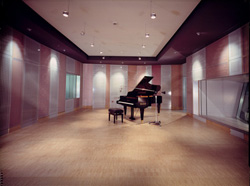
A with Bösendorfer Grand Piano
Studio A, the
primary control room (24'6" deep by 22' wide), faces the main
tracking room (21'3" wide by 38'6" long by 14' high) and
can accommodate up to 35 musicians. The control room adjoins three
isolation booths that lead into the main tracking room.
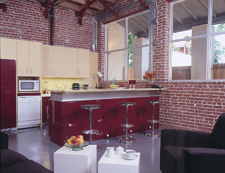
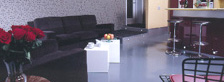
A first-class lounge and kitchen, complete with an outside patio,
ensure the ultimate comfort and privacy for clients. Along
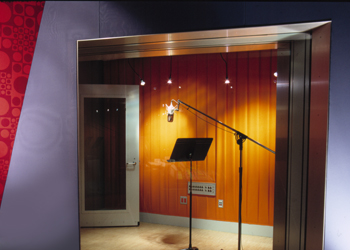
the east side of the building are two smaller control rooms that
share a vocal/instrument ISO booth (9'6" deep by 8' wide).
control room B
Studio B (13'4"
long by 10'10" wide), the larger of the two 5.1 control rooms,
shares a wall with Studio A's tracking room. A glass window provides
good line of sight. In fact, if necessary, Studio B can be used
as a control room for Studio A's main tracking room or as an additional
ISO booth for Studio A.
Studio C, the
smallest control room (13'4" long 10'1" wide) is used
to create the audio programming for United Airlines and Air Force
One and Two.
In addition
to Studios A, B and C, there are two other rooms set up to facilitate
audio post-production work, one of which has been contracted for
the next two years by film composer Mark Mancina (Haunted
Mansion and Brother Bear) also created the music for Disney's theatrical
release of Tarzan. Mark, recognizing the power and flexibility that
this facility has, set up his room to network with Studio A and
with his studio in Lake Arrowhead.
The studio's
audio and data network wiring, designed by industry veteran Paul
Cox, snakes through the new walls. For now, all computers are connected
via Ethernet, but the studio is equipped for fiber-optic cables
in the very near future. In addition, every room (including the
offices, kitchen, and outdoor patio) has its own audio tie-lines.
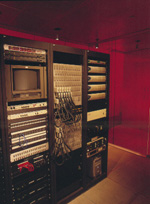
All tie-lines go through the machine room, in which pairs of 8-channel
Elco connectors provide patching access to all rooms. Studio A has
80 channels of inputs and outputs, while the small studios have
24 channels and the offices each have 16.
"When it
came to equipment, Firehouse Recording Studios wanted to combine
the latest in computer-based digital recording with classic analog
gear - striking a balance between old and new, past and future.
Still, the appeal of analog's warm sound is undeniable, and, through
this combination, that warmth can be captured in a digital recording.
That said, Firehouse Recording Studios offers the best of both worlds,"
says Stewart.
Firehouse Microphone
cabinet offers an extensive collection of industry standards like:
Neumann TLM170s, KM84s, U89s, U8s, AKG 414s, KM184's and 480s; Electrovoice
RE15s and RE20s; Sennheiser 421s; Schoeps and Shure SM57. Plus,
you can find the much desired tube mics, including a classic AKG
C24 stereo mic and Neumann M49's. Newer tube mics include a Microtech
Gefel (which is a little brighter than some other tube mics but
still very warm), two Neumann M149s and the Blueberry.
Firehouse Recording
Studios will offer complete concierge services, including access
to world-class hotels, restaurants and spas. Located in the heart
of historic Pasadena, it is within walking distance from some of
southern Californias finest restaurants and shops.
In building
one of the nations finest recording centers, we have assembled
a stable of the best equipment and technology available, including
the latest in computer and digital technology, the best in microphone,
speaker and display technology, the best in construction and acoustics,
and to top it all off, a #225 74Bösendorfer Grand
Piano, says CEO, Tena Clark.

Contact:
Candace Stuart, studio manager
Ed Wooley, Chief Engineer/Tech
626-405-0411 fn
626-405-0413 fx
web: Firehouse
Recording Studios
While in Pasadena,
visit:
Burke Williams
Day Spa
Pasadena's Ritz Carlton Hotel
The Norton Simon Museum of Art
The Huntington Library and Gardens
|